
 Independent third-party compliance service provider · Not a regulator or approving authorityRengangyongsheng (Hong Kong) Limited
Lithuanian Financial Licences
Applications · Acquisitions · Ongoing Compliance
Lithuania is a member of the EU and the euro area, and an important base for European fintech, electronic money, international payments, digital banking and crypto-asset services businesses. RGYS provides an overview of Lithuania's and the EU's financial regulatory frameworks, covering 64 licence and registration categories, and offers end-to-end support with Lithuanian company formation, bank account opening, annual compliance, bookkeeping and tax filing.

We provide professional advisory services for applications for Lithuanian and EU financial licences, acquisitions of licensed companies, company formation and ongoing compliance; all licences and authorisations Final approval authority rests with the Bank of Lithuania (Lietuvos bankas), the European Central Bank and other competent authorities, we do not guarantee approval.
About RGYS →Lithuania and the EU financial regulatory framework
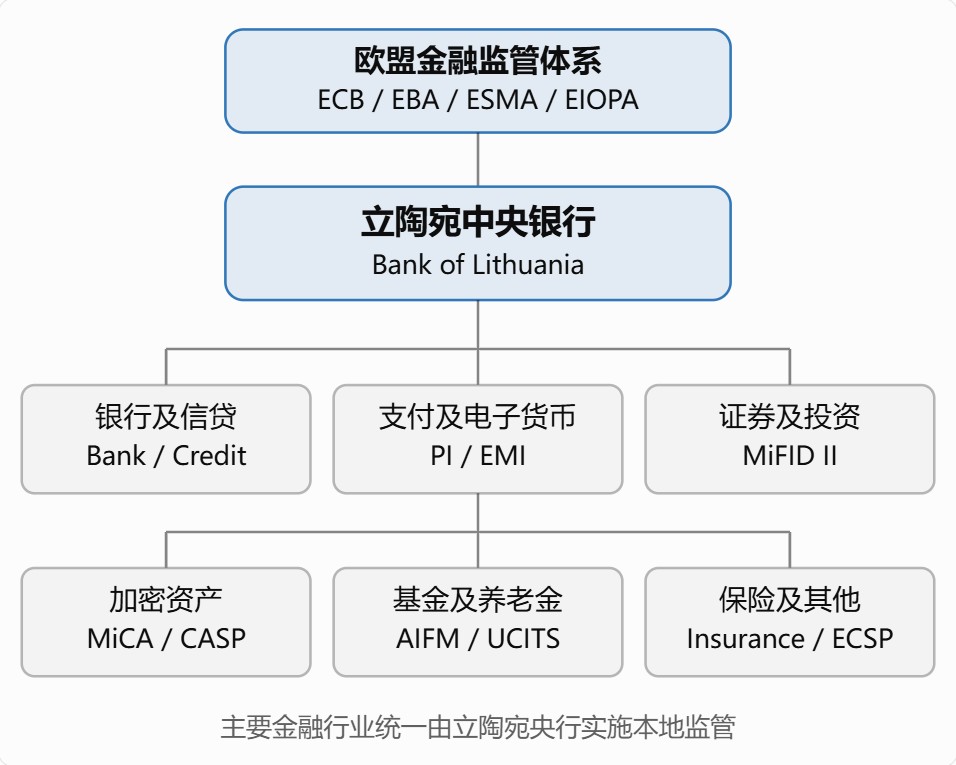
Unlike Cyprus, the UK and Dubai, Lithuania adopts Centralised financial supervision : the vast majority of financial institutions are Bank of Lithuania (Lietuvos bankas, LB) Uniformly responsible for authorisation, registration and ongoing supervision; banking authorisation falls within the European Central Bank's (ECB) Single Supervisory Mechanism.
At EU level, EBA, ESMA and EIOPA establish harmonised supervisory standards, while AMLA and Lithuania's Financial Crime Investigation Service (FNTT) together form the anti-money laundering supervisory framework.
All licence categories · listed individually

Approval of full-service banks, specialised banks, credit unions, branches of foreign banks and financial holding companies. Bank authorisation is jointly assessed by the European Central Bank and the Bank of Lithuania under the Single Supervisory Mechanism (SSM).
View this section 5 licences
Full EMI, restricted EMI, Full PI, restricted PI, AISP, PISP, remittance services and agent/distributor registration, including access to the CENTROlink payment system.
View this section 8 licences
Licensing for currency exchange, consumer credit, real estate credit, P2P lending platforms, European Crowdfunding Service Providers (ECSPs) and credit servicers.

Class A/B/C financial brokerage firms, financial advisory firms, tied agents, trading venue operators and fund depositaries.

UCITS management companies, management companies for collective investment undertakings for informed investors, AIFMs, various investment funds, EuVECA/EuSEF/ELTIF, securities issuance and DLT pilot infrastructures.
View this section 7 licences
MiCA CASP Classes 1, 2 and 3, ART/EMT issuers, white paper notifications, Article 60 notifications for existing licensed institutions, and the status of legacy VASP registrations and transition pathways.

Life, non-life and reinsurance companies; insurance brokers and various types of insurance intermediary; pension fund management companies; and Pan-European Personal Pension Products (PEPPs).
Priority licence areas
Key changes in 2026
A legacy VASP registration is no longer a current authorisation to operate. Lithuania's MiCA transitional period ended on 31 December 2025, while the maximum transitional period at EU level runs until 1 July 2026. As instructed, the Bank of Lithuania has blocked 27 crypto-asset service websites without MiCA authorisation.
EMI/PI Supervision Is Becoming Stricter In 2025, the LB conducted 15 targeted inspections of the EMI/PI sector, imposed 19 sanctions and issued 91 improvement notices, focusing on AML/KYC, fraud risk, safeguarding of client funds and own funds.
CENTROlink rules update. A new indirect participation model will be introduced in 2027, and the SDD rate will be reduced.
New application or acquisition of a licensed company?
- Establish a UAB from scratch and submit a complete application to the LB
- Business model, governance and personnel can be tailored to your needs
- Pass a five-working-day formal check and substantive review
- Statutory review period: usually 3 months for EMI/PI and 6 months for FBF/UCITS

- A licence cannot be bought or sold separately from the legal entity; in practice, the transaction is an acquisition of 100% of the shares
- Obtain prior regulatory consent for qualifying holdings
- Must complete legal, financial, AML and regulatory history due diligence
- A legacy VASP company must not be sold as holding a valid CASP licence
Lithuanian Company Formation, Account Opening, Annual Compliance and Tax
Lithuania offers more than just the most common UAB. Shareholder liability, capital arrangements, governance bodies, financing methods and whether the entity has separate legal personality all affect the choice of company form.
Lithuanian company formation typically involves choosing a name, preparing incorporation documents, arranging a business address and paying in capital before registration with the Register of Legal Entities. Foreign shareholders should also plan in advance for certification, translation and the chain of authorisations.
A Lithuanian company can compare local banks, digital banks and EMI/PI accounts, but the nature of the accounts, client funds protection and bank KYC outcomes differ.
The core annual compliance obligations of an ordinary company are to hold the annual general meeting on time, prepare and approve the financial statements, file documents with the Register of Legal Entities, and keep JANGIS and tax records up to date.
Accounting for Lithuanian businesses involves more than entering invoices. It also covers supporting documents, payroll, VAT, electronic filings, management reports, financial statement classification and audit judgements.
Lithuanian company tax requires separate consideration of corporate income tax, dividends, VAT, payroll withholding, cross-border services and tax incentives. Rates should also be checked against the relevant tax year and transitional provisions.
When hiring employees or appointing directors in Lithuania, also consider employment contracts, PIT, Sodra, employer registration, work permits and the basis for residence.
Changes to shareholders, directors, articles of association, registered address, capital and shares must follow the relevant registration and regulatory procedures. Deregistration generally requires liquidation, settlement of creditors' claims and final registration, rather than simply deleting the company.
Key Advantages of Lithuanian Financial Licences
As a member of the EU and the euro area, Lithuania enables eligible licensed firms to expand into other applicable Member States through EU passporting.
Most financial institutions other than banks are authorised and supervised centrally by the Bank of Lithuania, with clear communication channels.
Tiered authorisations for full-scope, limited, AISP, PISP and remittance services, tailored to payment businesses of different sizes.
A specialised bank has minimum initial capital of €1,000,000 and must still meet bank-level governance, capital and liquidity requirements.
Eligible banks, EMIs and PIs may apply for access to the SEPA payment infrastructure operated by LB.
CASP Classes I, II and III correspond to different services and capital requirements. Legacy VASP registration no longer qualifies as a current authorisation.
The LB Newcomer Programme allows applicants to discuss their business plan and regulatory issues before formal submission.
The licence attaches to the legal entity, and acquiring a licensed company requires prior approval for a qualifying holding. The route is lawful and viable.
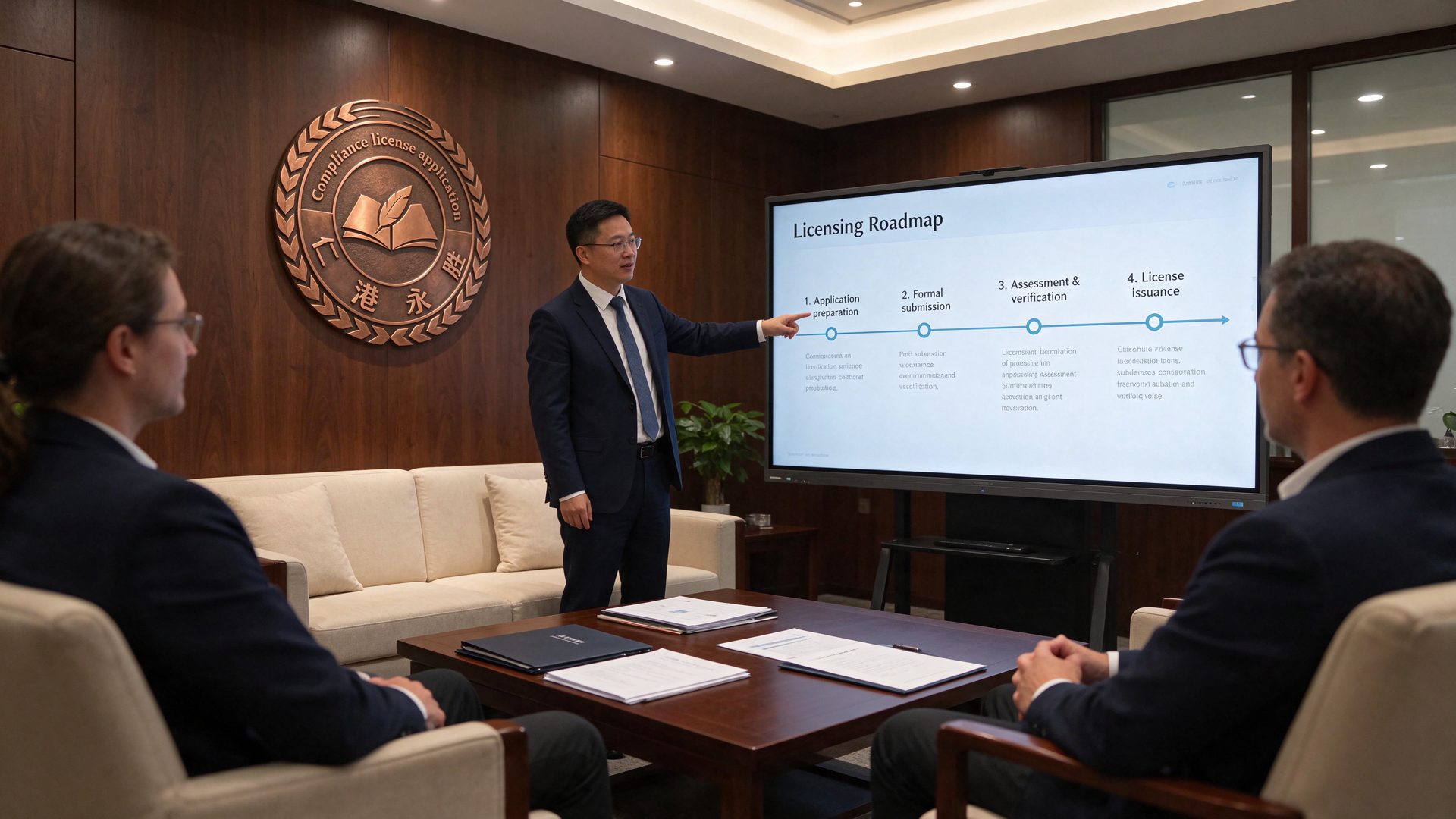
Application process
Confirm the business model, licence category and route of a new application or acquisition
Compile pre-engagement materials and a question list for the Newcomer Programme
Establish a UAB and put in place a board and key compliance, risk management and AML functions
Business plan, financial forecasts, AML, ICT/DORA and safeguarding arrangements
After a 5-working-day formal check, the application proceeds to substantive assessment; we coordinate any requests for additional information
Capital Funding, Systems and Policies Going Live, Accounts and CENTROlink Access
Regulatory Reporting, AML, Audit, Annual Compliance and Material Change Notifications
Assistance with prior approval for changes to qualifying holdings, directors and key persons
Independent Third Party · Clear Boundaries
Rengangyongsheng (Hong Kong) Limited is an independent third-party compliance service provider, Not a regulatory, approval or licensing authority in Lithuania or the EU. Licensing decisions are made independently by the regulator. We do not guarantee approval or make approval a condition of our fees.

Frequently asked questions
Q01Is RGYS a regulatory authority?+
Q02Can approval be guaranteed?+
Q03Why should business model and licence alignment be assessed first?+
Q04Do you need a local office to apply for a Lithuanian licence?+
Q05What materials will the regulatory authority focus on?+
Q06How does the Newcomer Programme relate to a formal application?+
Q07What are the main differences between a Full EMI and a Full PI?+
Q08Are a Restricted EMI or Restricted PI suitable for cross-border business?+
Book a Free Assessment

 This article is by Rengangyongsheng (Hong Kong) Limited Prepared by, and explained by Tang Shangyong (Drew) Professional guidance from a Business Manager· Information updated: November 2026