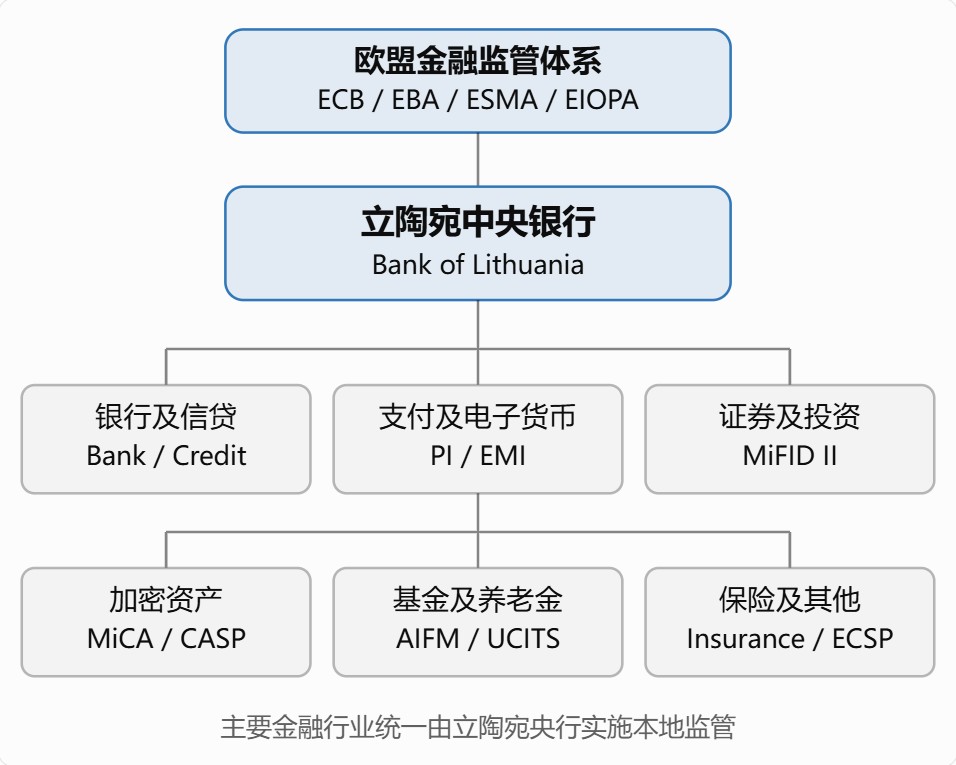
| LT-01 | Full-service bank licence | Bank Licence | ECB/LB | Licence |
| LT-02 | Specialised bank licence | Specialised Bank Licence | ECB/LB | Licence |
| LT-03 | Credit Union Licence | Credit Union Licence | LB | Licence |
| LT-04 | Central credit union licence | Central Credit Union Licence | LB | Licence |
| LT-05 | Full electronic money institution licence | Electronic Money Institution Licence | LB | Licence |
| LT-06 | Restricted electronic money institution licence | Electronic Money Institution Licence for Restricted Activity | LB | Licence |
| LT-07 | Full payment institution licence | Payment Institution Licence | LB | Licence |
| LT-08 | Restricted payment institution licence | Payment Institution Licence for Restricted Activity | LB | Licence |
| LT-09 | Account information service provider | Account Information Service Provider | LB | Dedicated authorisation / registration |
| LT-10 | Payment initiation service provider | Payment Initiation Service Provider | LB | PI business permissions |
| LT-11 | Remittance and cross-border transfer business | Money Remittance Services | LB | PI business permissions |
| LT-12 | Currency exchange service provider | Currency Exchange Operator | LB | Registration |
| LT-13 | Consumer credit service providers | Consumer Credit Provider | LB | Registration |
| LT-14 | Consumer credit intermediary | Consumer Credit Intermediary | LB-related regulation | Registration |
| LT-15 | Real estate-related credit institutions | Real Estate Related Credit Provider | LB | Registration |
| LT-16 | Independent mortgage credit intermediary | Independent Mortgage Credit Intermediary | LB | Registration |
| LT-17 | Tied Mortgage Credit Intermediary | Tied Mortgage Credit Intermediary | LB-related regulation | Registration |
| LT-18 | P2P Lending Platform Operators | Peer-to-Peer Lending Platform Operator | LB | Registration |
| LT-19 | Real estate-related P2P lending platform | Real Estate Related P2P Lending Platform | LB | Registration |
| LT-20 | European crowdfunding service providers | Crowdfunding Service Provider | LB | Licence |
| LT-21 | Credit Asset Servicing Institution | Credit Servicer | LB | Licence |
| LT-22 | Credit Asset Purchaser | Credit Purchaser | LB-related regulation | Statutory obligations |
| LT-23 | Payment institution agent | Payment Institution Agent | LB | Registration |
| LT-24 | E-money Agents and Distributors | Electronic Money Institution Agent/Distributor | LB-related regulation | Registration or notification |
| LT-25 | Financial Holding Company | Financial Holding Company | ECB/LB | Applicable authorisation |
| LT-26 | Category A financial brokerage company licence | Category A Financial Brokerage Firm | LB | Licence |
| LT-27 | Class B Financial Brokerage Firm Licence | Category B Financial Brokerage Firm | LB | Licence |
| LT-28 | Class C Financial Brokerage Firm Licence | Category C Financial Brokerage Firm | LB | Licence |
| LT-29 | Financial Investment Adviser Firm Licence | Financial Adviser Company | LB | Licence |
| LT-30 | Public Securities Fund Management Company | UCITS Management Company | LB | Licence |
| LT-31 | Informed Investor Collective Investment Management Company | Management Company for Informed Investors | LB | Licence |
| LT-32 | Alternative investment fund managers | Alternative Investment Fund Manager | LB | Licence |
| LT-33 | EU Public Investment Funds | UCITS Fund | LB | Fund Authorisation |
| LT-34 | Alternative investment funds | Alternative Investment Fund | LB | Fund Authorisation or Registration |
| LT-35 | Informed Investor Collective Investment Fund | Collective Investment Undertaking for Informed Investors | LB | Fund Authorisation |
| LT-36 | Self-managed investment company | Self-managed Investment Company | LB | Applicable authorisation |
| LT-37 | European Venture Capital Funds | European Venture Capital Fund (EuVECA) | LB | Registration eligibility |
| LT-38 | European Social Entrepreneurship Funds | European Social Entrepreneurship Fund (EuSEF) | LB | Registration eligibility |
| LT-39 | European Long-Term Investment Funds | European Long-Term Investment Fund (ELTIF) | LB | Fund Authorisation |
| LT-40 | Operator of a regulated securities market | Regulated Market Operator | LB | Market authorisation |
| LT-41 | Multilateral trading facility operator | Multilateral Trading Facility (MTF) | LB | Business authorisation |
| LT-42 | Operator of an organised trading facility | Organised Trading Facility (OTF) | LB | Business authorisation |
| LT-43 | Investment services tied agent | Tied Agent | LB-related regulation | Registration |
| LT-44 | Fund Depositary | Fund Depositary | LB | Eligibility requirements for applicable institutions |
| LT-45 | Securities issuance institutions | Securities Issuer | LB | Ongoing regulatory oversight |
| LT-46 | Distributed ledger financial market infrastructure. | DLT Market Infrastructure | LB, etc. | Dedicated licence |
| LT-47 | MiCA Crypto-Asset Service Provider | Crypto-Asset Service Provider (CASP) | LB | Licence |
| LT-48 | Issuer of asset-referenced tokens | Issuer of Asset-Referenced Tokens (ART) | LB/EBA | Applicable authorisation |
| LT-49 | E-money Token Issuer | Issuer of Electronic Money Tokens (EMT) | LB/ECB/EBA | Bank or EMI Status and MiCA Requirements |
| LT-50 | Issuers of Other Crypto-Assets | Issuer of Other Crypto-assets | LB | Applicable white paper notification and disclosure |
| LT-51 | Crypto-asset services provided by existing licensed institutions | Crypto Services by Existing Financial Institutions | LB, etc. | Dedicated notification mechanism |
| LT-52 | Registration of an old virtual asset service provider | Virtual Asset Service Provider (Legacy VASP) | Former FNTT-related AML supervision | Historical registration, no longer valid as a current authorisation to operate |
| LT-53 | Life insurance company | Life Insurance Undertaking | LB | Licence |
| LT-54 | Non-life insurance company | Non-Life Insurance Undertaking | LB | Licence |
| LT-55 | Reinsurance Company | Reinsurance Undertaking | LB | Licence |
| LT-56 | Insurance brokerage company | Insurance Brokerage Firm | LB | Applicable licence/registration |
| LT-57 | Insurance agent | Insurance Agent | LB-related regulation | Registration |
| LT-58 | Reinsurance Intermediary Firm | Reinsurance Intermediary | LB-related regulation | Registration |
| LT-59 | Ancillary insurance intermediary | Ancillary Insurance Intermediary | LB-related regulation | Applicable registration |
| LT-60 | Pension Fund Management Company | Pension Fund Management Company | LB | Management company authorisation |
| LT-61 | Second-pillar pension fund | Second Pillar Pension Fund | LB | Fund Supervision |
| LT-62 | Third-pillar voluntary pension fund | Third Pillar Pension Fund | LB | Fund Supervision |
| LT-63 | Occupational Pension Funds | Occupational Pension Fund | LB | Applicable authorisation and registration |
| LT-64 | Pan-European Personal Pension Product | Pan-European Personal Pension Product (PEPP) | LB, etc. | Product registration |