

Financial Regulatory System in Lithuania and the EU
Lithuania operates a centralised financial regulatory system centred on the Bank of Lithuania (Lietuvos bankas). Banking authorisation is incorporated into the European Central Bank's Single Supervisory Mechanism, while the EBA, ESMA, EIOPA and AMLA establish harmonised rules at EU level.
Regulatory Structure Overview
EU Level: ECB (Single Supervisory Mechanism, bank authorisation and supervision of significant institutions), EBA (banking and payments), ESMA (securities, funds and MiCA coordination), EIOPA (insurance and pensions), AMLA (AML).
At Lithuanian level: Bank of Lithuania (LB) To distinguish the financial regulators and licensing authorities: FNTT is responsible for financial intelligence and AML; Registrų centras is responsible for registering legal entities and beneficial owners; VMI and Sodra are responsible for tax and social security.
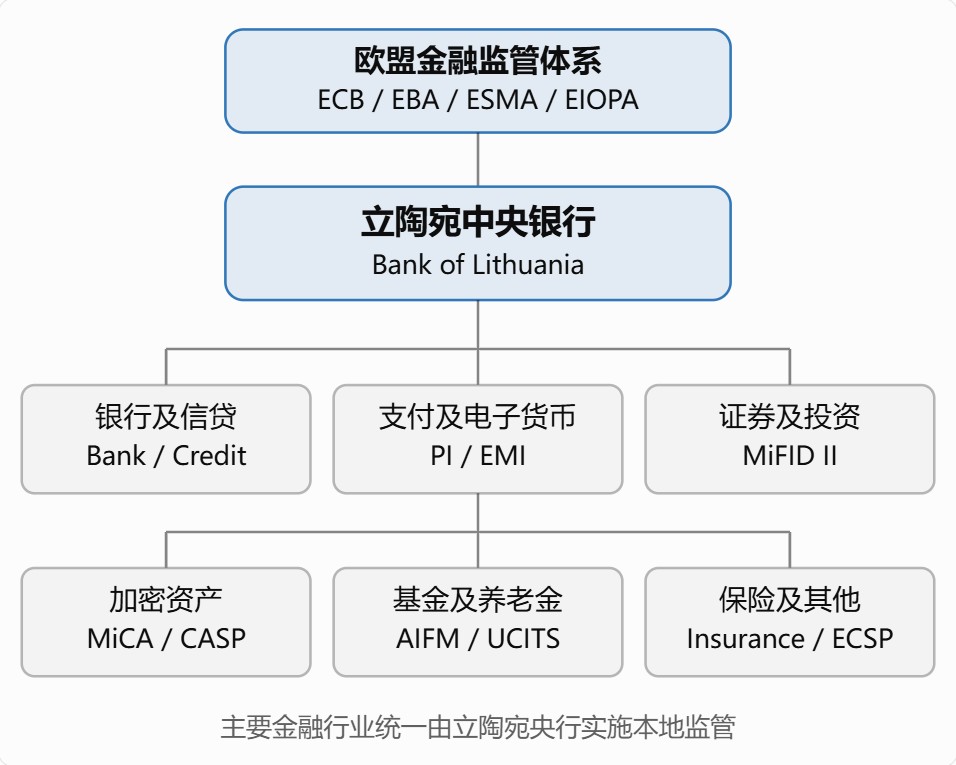
The Bank of Lithuania (Lietuvos bankas, LB) is responsible for authorising and continuously supervising a wide range of banking, payment, electronic money, insurance, securities, fund, credit and crypto-asset activities.

Lithuania is within the euro area's Single Supervisory Mechanism (SSM). Banking licences, qualifying holdings and ongoing prudential supervision are handled through cooperation between the ECB and the Bank of Lithuania according to their respective responsibilities.
The EBA, ESMA and EIOPA develop and coordinate EU regulatory standards for banking, securities, insurance and pensions, forming a multi-tiered framework alongside the Bank of Lithuania (LB)'s local authorisation and ongoing supervision.

The EU's AMLA, AMLR and AMLD6, together with Lithuania's Financial Crime Investigation Service (FNTT/FCIS), form the new anti-money laundering and counter-terrorist financing supervisory framework. Businesses need to understand direct supervision, national financial intelligence and reporting obligations.
Registrų centras administers important registers, including the Register of Legal Entities, and provides services relating to legal entities, beneficial owners, real estate and electronic submissions.
VMI administers taxation, while Sodra is responsible for state social insurance and related contributions. After company formation, tax, VAT, payroll withholding and social insurance should be managed separately according to the relevant status and filing calendar.
In addition to the LB, ECB, VMI and Sodra, businesses may also engage with the Ministry of Finance, AVNT, the Gambling Supervisory Authority, the Competition Council, VDAI, Nasdaq Vilnius, Nasdaq CSD and the deposit insurance institution.