Keywords · KEYWORDSClass C financial brokerageFinancial Brokerage LicenceInvestment adviceOrder transmissionPortfolio managementDoes not hold client assetsMiFID II
Class C Financial Brokerage Firm Licence
LT-28 · Securities investment and market infrastructure

Class C Financial Brokerage Firm Licence

Category C Financial Brokerage Firm

Order transmission, investment advice and portfolio management services for clients whose assets are not held.

Open for new applicationsLicensing authority: Bank of LithuaniaPrioritisation of market entry
Ongoing minimum capital
€75,000
Substantive review period
6 months after the information is complete
State fee
€947
Customer assets
Must not hold
Legal Basis · LEGAL BASIS
  • Law on Markets in Financial Instruments (LMFI)
  • MiFID II (Directive 2014/65/EU) and Annex I, Sections A, B and C
  • IFR (Regulation (EU) 2019/2033) and IFD (Directive (EU) 2019/2034, including the initial capital framework under Article 9)
  • Lithuanian rules on customer protection, AML/CTF and investor compensation schemes
Key Summary · AT A GLANCE
Capital: €75,000 permanent minimum initial capital; ongoing own funds are the highest of one quarter of fixed overheads, the K-factor requirement and the permanent minimum capital under IFR/IFD
Time: No later than 6 months after the information is complete; supplementary information and changes to the scope of business may affect the timeline
State fee: €947 state fee; annual supervisory fees to be confirmed in accordance with LB's latest arrangements
EU Passporting: Provide approved investment services in other EEA markets, subject to meeting passporting notification and host-country requirements
01

Scope of permissions and business boundaries

Permitted Activities & Boundaries

A Class C financial brokerage firm is suited to a limited investment services model that does not involve holding client funds or financial instruments. It may apply to receive and transmit orders, execute transactions on behalf of clients, provide investment advice and portfolio management, and undertake non-underwritten placing.

The A, B and C matrix provides an indication of business boundaries at category level. A licence ultimately covers only those activities for which the applicant demonstrates adequate personnel, systems, governance and risk controls.

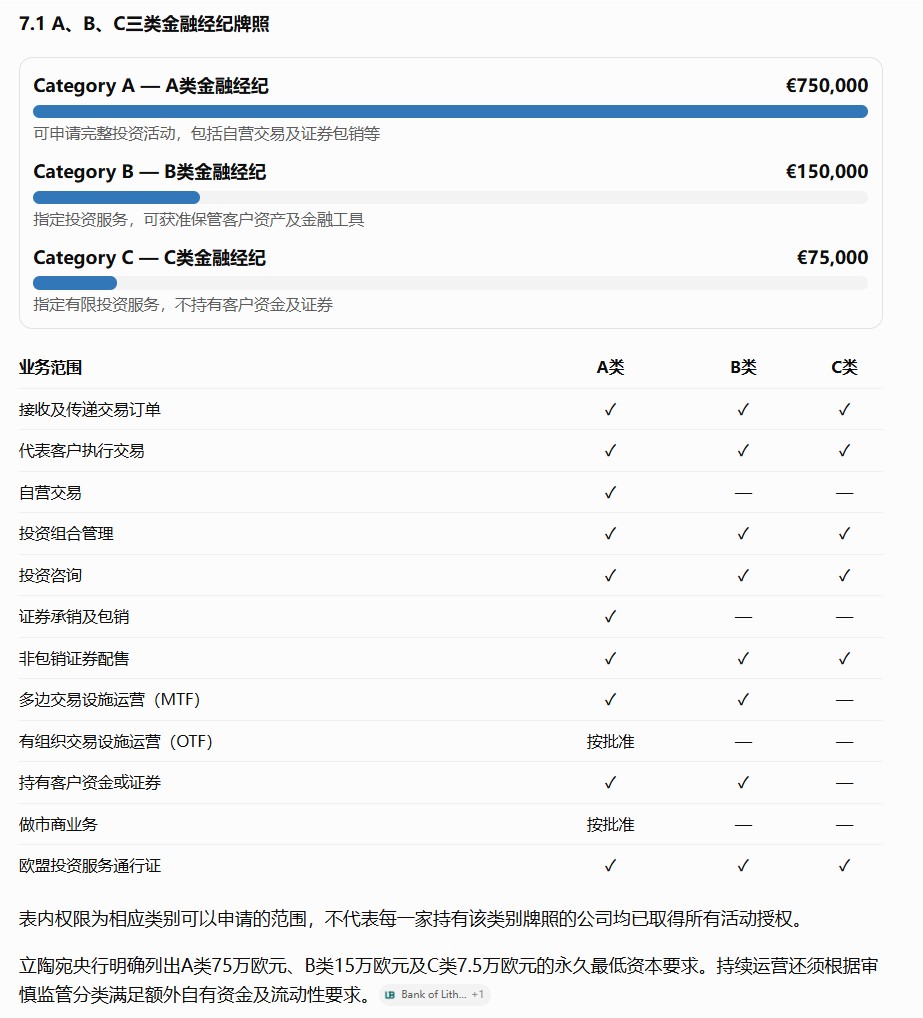
Scope of businessClass ACategory BClass C
Reception and transmission of transaction orders✓✓✓
Executing transactions on behalf of clients✓✓✓
Own-account dealing✓——
Portfolio management✓✓✓
Investment advice✓✓✓
Securities underwriting and firm commitment underwriting✓——
Non-underwritten securities placement✓✓✓
Operating a multilateral trading facility (MTF)✓✓—
Operation of an organised trading facility (OTF)Subject to approval——
Holds client funds or securities✓✓—
Market-making activitiesSubject to approval——
EU Investment Services Passport✓✓✓
Comparison of the business scopes of financial brokerage firms in categories A, B and C; the table shows the scope that may be applied for and does not mean that all activities are automatically authorised.
MiFID II Annex I, Section AInvestment service or activity
1Reception and transmission of orders in one or more financial instruments
2Executing orders on behalf of clients
3Own-account dealing
4Portfolio management
5Investment advice
6Underwriting or placing financial instruments on a firm commitment basis
7Placement of financial instruments on a non-firm commitment basis.
8Operate a Multilateral Trading Facility (MTF)
9Operate an Organised Trading Facility (OTF)
Nine Investment Services and Activities under MiFID II Annex I, Section A
MiFID II Annex I, Section BAncillary services
1Safekeeping and administration of financial instruments, including custody and related services
2Provide investors with credit or loans to enable them to carry out one or more transactions in financial instruments.
3Corporate finance advice, including advice on mergers and acquisitions and corporate restructuring
4Foreign exchange services related to the provision of investment services
5Investment research, financial analysis or other forms of general investment recommendation
6Services related to underwriting
7Services relating to underlying assets of derivatives listed in Part C of Annex I
Seven Ancillary Services under MiFID II Annex I, Section B
Financial Instruments under MiFID II Annex I, Section CExamples of common products
1Transferable securities: shares, bonds and other securities
2Money market instruments
3Units or shares in a collective investment undertaking
4Options, futures, swaps, forward rate agreements and other derivative contracts
5Derivatives on commodities and other non-financial underlying assets
6Contracts for differences and other cash-settled instruments
7Derivatives relating to underlying assets such as climate variables, freight rates, emissions allowances or inflation rates
8Credit risk transfer derivatives
9Financial contracts for difference and other derivatives qualifying as financial instruments
The specific product scope must be determined by the application documents, product structure and list of financial instruments approved by LB.
Limits of authorisation
Sections A, B and C of Annex I to MiFID II together form the framework for defining the scope of an application. Whether products such as shares, bonds, fund units, foreign exchange and derivatives may actually be traded depends on the financial instruments specified in the application, the target clients, the transaction process and the LB authorisation decision.

02

Applicable scenarios and advantages

Use Cases & Advantages

Suitable for asset-light brokerage, advisory or portfolio management models; not holding client assets can reduce the complexity of client asset safeguards and reconciliation arrangements, but does not remove obligations relating to appropriateness, transaction reporting or conduct of business.

  • Where applicable conditions are met and cross-border notification has been completed, use the EU investment services passport to provide authorised services in other EEA markets.
  • Apply for a combination of MiFID II investment activities and ancillary services under Section B of Annex I, as required by the business.
  • The scope of business, customer types, financial instruments and operating territories can be clearly separated in the application documents, making it easier to control the boundaries of the licence.
  • The LB's assessment focuses on governance, compliance, risk, safeguarding of client assets, AML/CTF, IT security and business continuity.
Practical boundaries
A licence category is not an automatic authorisation to conduct every type of business. In particular, MTF, OTF, market making, underwriting, custody of client assets and derivatives activities must each be justified separately in the business plan, systems and controls, and staff qualifications.
03

Application and eligibility requirements

Eligibility & Entry Conditions

To apply for a Class C financial brokerage firm licence, an entity in an appropriate legal form should generally first be established in Lithuania. It should then prepare an executable business plan, financial projections and operational controls tailored to the investment services proposed. The Class C capital threshold is only an entry requirement; it does not replace prudential, conduct or organisational requirements.

  • Describe target clients, products, trading venues, order routing, execution policy and expected business volumes.
  • Demonstrate that shareholders' source of funds is clear and that the UBO and direct and indirect ownership chains are verifiable.
  • Establish a framework for compliance, risk management, client asset protection, complaints, AML/CTF, transaction reporting and record-keeping.
  • Prepare IT architecture, cybersecurity, outsourcing, disaster recovery and business continuity arrangements, and identify key suppliers.
  • Put in place investor compensation schemes, professional indemnity insurance and any other applicable insurance or protection arrangements according to the scope of business.
Completeness requirements
The Bank of Lithuania (LB) usually first checks formal completeness before proceeding to substantive review. Missing information, a complex shareholder structure or a cross-border business model may mean that requests for further information and explanations affect the overall timetable.
04

Shareholders, directors and compliance staff

Shareholders, Directors & Key Persons

The Board of Directors, administrative manager, compliance, risk, internal audit and other key function holders should have a reputation, experience and qualifications appropriate to Class C business. LB will assess whether these functions are genuinely independent, whether resources are sufficient and whether key personnel can perform their duties on an ongoing basis, taking into account the scale and complexity of the business.

  • Submit CVs, qualifications, declarations of integrity and criminal record or regulatory disciplinary information for directors, the head of administration and key function holders.
  • Explains the segregation of responsibilities between compliance, risk management and internal audit, and direct reporting lines to the board where necessary.
  • Disclose shareholders, UBOs, controllers and related parties, explaining intra-group transactions, sources of funds and potential conflicts of interest.
  • Changes to directors and key personnel generally require prior notification or LB's non-objection under the applicable rules; appointments cannot be made first and reported afterwards.
Staffing
The official review did not confirm a fixed number of staff applicable to all financial brokerage firms, or a requirement for all key functions to be performed by Lithuanian residents. Staffing should be assessed case by case in light of the scale of the business and LB's latest requirements.
05

Capital and financial requirements

Capital & Financial Requirements
Capital ItemsApplicable requirements
Ongoing minimum capital€75,000
Fixed management fee methodologyOne quarter of the fixed annual management fee
K-factor methodK-factor own funds requirement calculated according to business, customer, transaction and asset risks
Ongoing own fundsThe highest of the permanent minimum capital, one quarter of fixed overheads and the K-factor requirement, while also meeting the other prudential requirements under IFR/IFD.
Liquidity and reportingMaintain and report on an ongoing basis in accordance with the investment firm category, risk profile and LB reporting rules
Class C Financial Brokerage Firm Capital and Ongoing Prudential Requirements
Initial capital
€75,000; used to demonstrate that the permanent minimum capital is in place at the time of application
Ongoing verification
Cannot simply maintain the initial capital figure; it must be recalculated periodically using the IFR/IFD methodology
Basis of applicability
IFR, IFD (including the initial capital framework under Article 9) and Lithuanian implementing rules
Ongoing capital: highest applicable amount
Ongoing capital is not the sum of three requirements; it is the highest amount after comparison under the applicable IFR/IFD methodology. K-factors, fixed overheads and permanent minimum capital may each be binding constraints. The actual calculation should also take account of scale, service categories, client assets and regulatory classification.
06

Office address and substantive operations

Office & Local Substance

A financial brokerage firm should maintain a supervisory-ready office and genuine operational substance in Lithuania, enabling effective management. The more complex the Class C activities, the more specific the evidence required for resources covering trading, risk, compliance, IT, client assets and business continuity.

  • Provide a verifiable registered address in Lithuania, office arrangements, staff work locations and regulatory contact channels.
  • Establish systems for order management, transaction records, recording or retaining electronic communications, regulatory reporting and protecting client information.
  • Conduct due diligence and ongoing monitoring of critical outsourcers, cloud services, brokers, custodians, trading venues and data providers.
  • Prepare disaster recovery, recovery time objectives, cyber incident response and contingency arrangements for key roles.
Local substance
A registered office address cannot replace effective management and operational capability. LB assesses whether the company has sufficient staff and systems, and a decision-making chain that can be supervised, to provide the investment services for which it is applying.
07

Required information and documents

Required Documents
  • Articles of association, registration certificate, board and shareholder structure chart
  • Identification documents and source-of-funds information for direct and indirect shareholders, UBOs and qualifying holders
  • Business plan, three-year financial forecasts, and capital and liquidity planning
  • List of the investment services, ancillary services, financial instruments and target clients covered by the application
  • Policies on client categorisation, appropriateness and suitability assessments
  • Order execution, best execution and order-routing policy
  • Procedures for customer asset protection, segregation, reconciliation and the treatment of shortfalls
  • Compliance Monitoring Programme, Risk Management Framework and Internal Audit Arrangements
  • AML/CTF, KYC, sanctions screening and suspicious transaction reporting procedures
  • Trading reporting, record-keeping, communications archiving and regulatory reporting arrangements
  • IT architecture, cybersecurity, data protection, disaster recovery and business continuity plan
  • Outsourcing, critical supplier, trading venue and custody arrangement documents
  • CVs and fitness and propriety documents for directors, executive officers and key function holders
  • Investor compensation schemes, insurance and other customer protection arrangements
  • Evidence of premises, budget, recruitment and staff training
Documentation depth
The document checklist must be tailored to the licence category and proposed activities. For a Class A application involving underwriting, dealing on own account, an MTF or an OTF, provide additional detailed materials on trading, market risk, conflicts of interest and venue operational controls.
08

Application and process

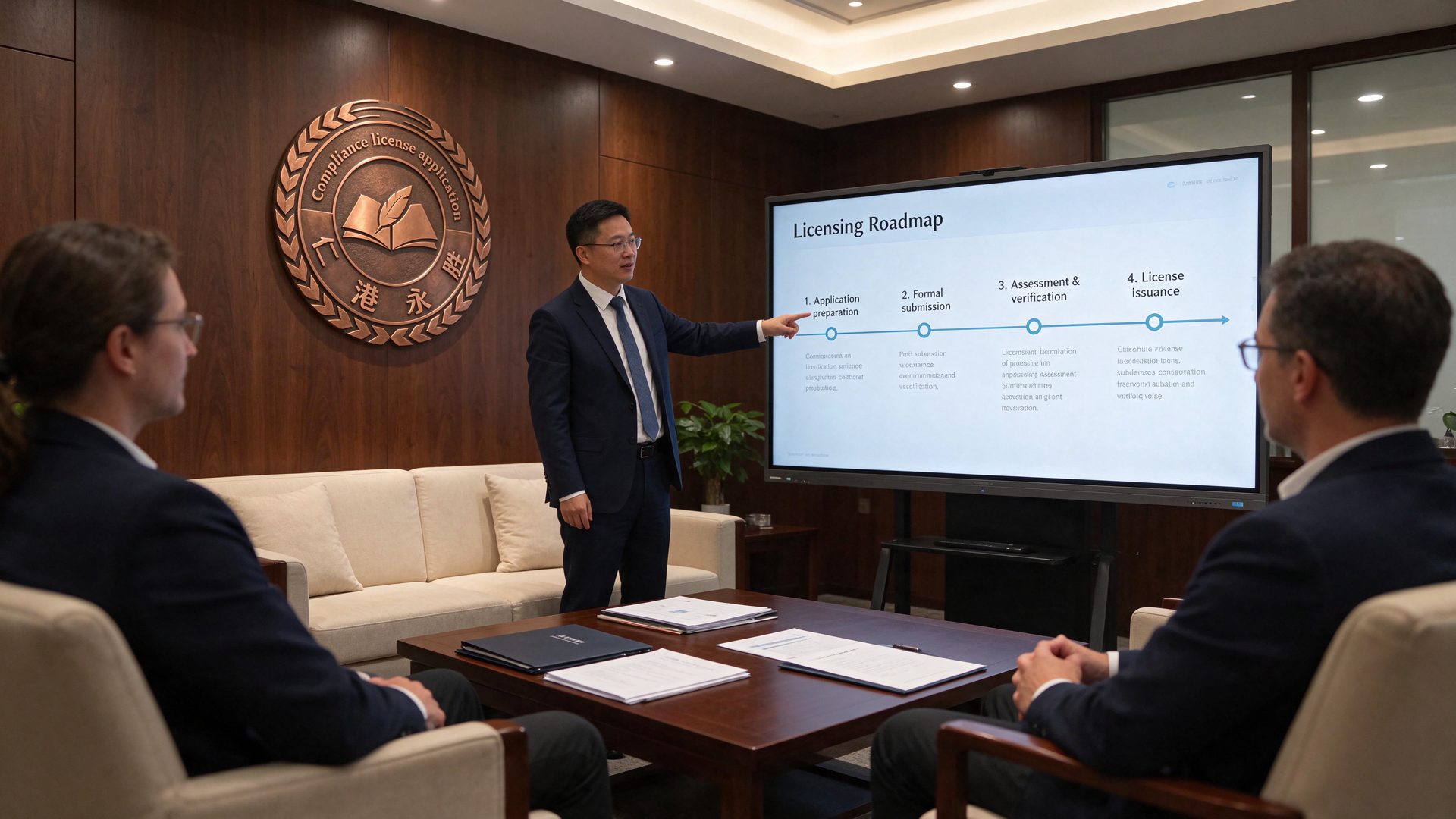
Application Process
01
1. Determine the scope of the licence
For Class C, define the target clients, investment activities, ancillary services, financial instruments and whether client assets are held.
02
2. Pre-application discussions and gap analysis
The basic business model may be discussed through the LB Newcomer Programme, followed by a gap analysis covering capital, personnel, systems and governance.
03
3. Establish or Prepare the Applicant Entity
Confirm the Lithuanian entity, registered address, shareholders and UBO chain, and establish the source of capital and key management personnel.
04
4. Prepare the Application Pack
Complete the application form, business plan, financial model, internal policies, customer asset arrangements, and IT and AML/CTF documentation.
05
5. Submit materials demonstrating formal completeness
Submit a complete application to LB and respond to the formal completeness check; incomplete documents may be required to be supplemented.
06
6. Proceed to substantive assessment
LB assesses governance, shareholders, business viability, capital, risk, compliance, IT, personnel and customer protection.
07
7. Responding to questions and submitting additional documents
Explain the business model, control evidence and source of funds against the regulatory issues checklist; avoid substituting high-level assurances for documented policies and procedures.
08
8. Obtaining the decision and preparing for launch
After approval, configure staffing, test systems, and complete filings and notifications within the scope of the licence. Activities must not begin before authorisation.
Review stages
According to official verification, the substantive review period for a complete application is no longer than 6 months; requests for additional documents, complex ownership structures or regulatory issues may affect the actual timescale. The list of activities in the authorisation decision defines the scope of permitted operations.
09

Timeline and key milestones

Timeline & Milestones
StageExpected timeframeOverview
Model and Documentation Gap Analysis2–6 weeksConfirm the scope of Class C activities, capital, personnel, systems and customer assets
Company and Governance Preparation4–8 weeksComplete arrangements for the entity, shareholding, directors and key functions
Application submission and formal checksInitial period after submissionThe LB first checks that the information is complete and may issue requests for clarification.
Substantive licence reviewNo later than 6 months after the information is completeReview the business plan, shareholders, management, capital and control framework
Pre-approval launch preparationsSubject to the maturity of the systemsComplete testing, reporting, outsourcing, staff training and customer documentation
Class C Financial Brokerage Firm Application Timeline
Timing notes
The 6-month period is the statutory review framework for complete documentation, not a guaranteed timeframe starting from the first contact or submission of an incomplete application; requests for additional information and material amendments may affect the review timetable.
10

Acquisitions and Material Changes

Acquisition & Material Changes

Acquiring a Class C financial brokerage firm means acquiring the legal entity behind it, not treating the licence as an asset that can be bought and sold separately from the company. Before the transaction, verify the permitted activities, actual business, regulatory history, client assets, capital shortfalls, outstanding matters and group arrangements.

  • Conduct due diligence on the target company's licence decisions, change records, regulatory inspections, penalties, complaints and outstanding remediation matters.
  • Obtain prior regulatory approval for a qualifying holding, or complete the applicable notification; do not circumvent scrutiny where a direct or indirect holding reaches a relevant threshold or gives rise to significant influence.
  • The transaction documents should provide for LB approval, source of funds, regulatory non-objection, completion conditions and an exit mechanism if material deficiencies are identified.
  • Changes to directors, executive officers and key function holders must be notified in advance or receive non-objection under the applicable procedure; acquisition closing cannot replace fitness and propriety review.
  • After completion, promptly update the shareholders, UBO, management, business plan, outsourcing and capital arrangements, and confirm that the existing authorised activities still cover the actual business model.
Conditions Precedent to Acquisition
A qualifying holding generally starts with direct or indirect ownership of 10% of the capital or voting rights, or the ability to exercise significant influence; subsequent increments such as 20%, 30% and 50% should also be checked in advance under the applicable rules. The specific review period is subject to confirmation by the LB, and requests for additional information may affect the timetable.
11

Ongoing maintenance and compliance

Ongoing Compliance & Maintenance
  • Continuously calculate own funds using the IFR/IFD methodology, taking the highest of the K-factors, one quarter of fixed overheads and the permanent minimum capital requirement.
  • Maintain controls for client classification, suitability, best execution, conflicts of interest, complaints and market conduct.
  • Complete transaction reporting, client asset reconciliation, regulatory reporting, audits, AML/CTF and risk reporting according to the scope of business.
  • Ongoing monitoring of changes to directors, key personnel, qualifying holdings, outsourcing, IT security, business continuity and organisational structure.
  • Do not expand the scope of investment activities, financial instruments, client asset services or cross-border activities without the applicable approval or notification from LB.
Ongoing mattersPractical requirements
CapitalRecalculate in accordance with the applicable K-factor and prudential methods, and retain supporting evidence
Customer assetsMust not hold client funds or financial instruments; ensure orders and client records remain verifiable
ReportingSubmit in accordance with LB, audit, AML/CTF, transaction and statistical calendars
ChangesAssess notification or approval requirements before changes to ownership, directors, key functions, outsourcing or business scope
Annual maintenance
Ongoing compliance is part of a licence's value. If capital falls below the applicable requirement, customer asset controls fail or actual business exceeds the permitted scope, remedial action should be taken immediately and LB contacted.
12

Application status

Application Availability

Class C financial brokerage firms may currently submit new applications under the LB's current licensing regime. However, suitability for a new entrant depends on whether its genuine business model, capital, staffing, client asset protection, IT and compliance systems can be implemented at the time of application.

  • Before making a formal application, you may use the LB Newcomer Programme for preliminary discussions; the programme is not a licence and does not replace formal scrutiny.
  • New applicants should first confirm whether their business requires FBF, fund management, MiCA CASP authorisation or another separate qualification, to avoid conflating crypto-asset spot services with MiFID investment services.
  • Market entry through acquisition of an existing entity may be assessed, but qualifying holdings, management fitness and regulatory history must be reviewed.
  • Cross-border operations must still comply with passporting notification requirements and host-country rules. A Lithuanian local licence does not automatically cover activities in all Member States.
Drew's Note
An open application process does not mean that LB will accept a shell model lacking substantive operational capacity. Newcomer pre-application discussions should focus on a verifiable business plan, the source of capital and evidence of control.
Tang Shangyong (Drew), Business Manager
Drew's Note Drew's Note
Drew's Note: Category C is suitable for asset-light models involving order transmission, investment advice or portfolio management, but asset-light does not mean light on compliance. The application documents must specify where orders go, who executes them, who safekeeps the assets, how advice is documented, and how the company prevents staff from crossing the boundary against holding client assets in practice.
Tang Shangyong (Drew) · Business Manager, Rengangyongsheng (Hong Kong) Limited
FAQ

Frequently Asked Questions About This Licence

Frequently Asked Questions
Q01Can a Class C financial brokerage firm provide investment advice?+
May provide investment advice within the scope of approval, and may also apply to receive and transmit orders, execute transactions on behalf of clients, manage portfolios or place financial instruments without a firm commitment basis. Operations must comply with client categorisation, suitability and record-keeping requirements; the authorisation decision is final.
Q02Why can't a Class C firm hold client funds or securities?+
Class C is based on a limited-service model that does not involve holding client funds or financial instruments. Client assets are handled by an authorised bank, custodian or other applicable institution. The Class C firm must still ensure that records of orders, client information, authorisation chains and asset transfers are complete and verifiable.
Q03Is €75,000 all that needs to be prepared for Class C?+
€75,000 is the permanent minimum capital requirement, not the only standard for ongoing capital. The firm must still calculate one quarter of its fixed overheads and its K-factor requirement under IFR/IFD, and maintain whichever is highest, while ensuring sufficient operational liquidity and compliance resources.
Tang Shangyong (Drew)This article is by Rengangyongsheng (Hong Kong) Limited Prepared by, and explained by Tang Shangyong (Drew) Professional guidance from a Business Manager· Information updated: November 2026

Enquire about FBF Category C

Book a Free Assessment
Tell us about your business model, target markets and shareholders. Drew's team will advise whether a new application or acquisition is more suitable, how to structure your capital and staffing, and the expected timeframe and budget.
RGYS advisory meeting
RGYS
Tell us about your project
Tell us about your project · Free Assessment
Success is displayed only after receipt has been confirmed by the service provider; if email is temporarily unavailable, please contact us via WhatsApp.